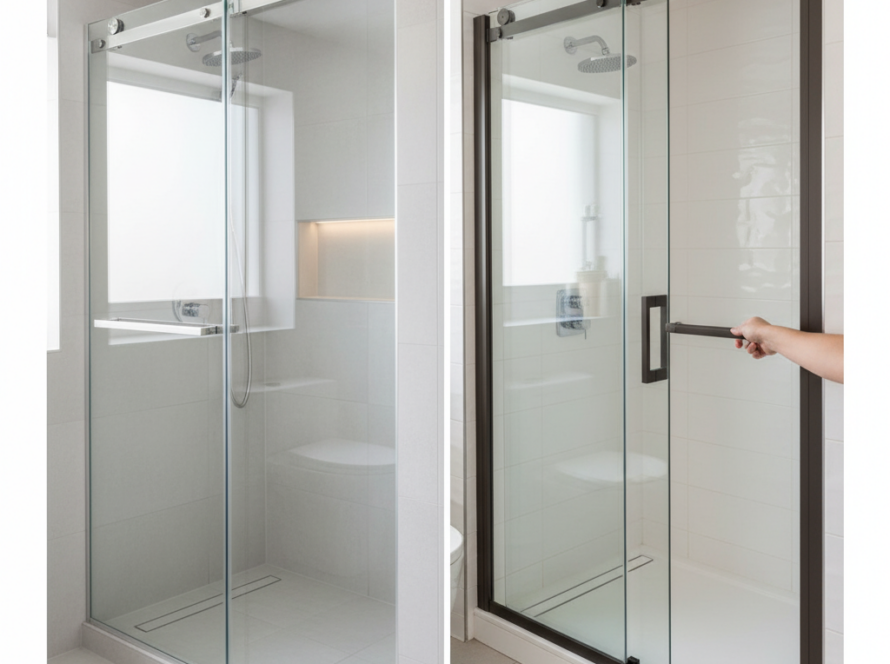
When a client, customer, or partner walks up to your building for the first time, the first thing they encounter isn’t your receptionist or your branding on the wall — it’s your door. Your commercial entrance glass is doing more work than most business owners realize. It’s communicating your brand values, managing security, controlling energy costs, and setting the tone for every interaction that follows.
Getting it wrong can mean drafty lobbies, shattered panes, sky-high insurance claims, or simply a first impression that feels dated and cheap. Getting it right? Your building entrance becomes a statement — a seamless blend of safety, style, and function that tells people exactly who you are before they step inside.
At Berwyn Glass, we’ve helped hundreds of businesses across every sector — from boutique retailers to corporate headquarters — choose the right glazing for their specific needs. This guide walks you through everything you need to consider when selecting commercial entrance glass, so you can make a confident, informed decision.
Why Your Business Entrance Door Matters More Than You Think
The business entrance door is the physical threshold between the public world and your private commercial space. It must satisfy a surprising number of competing demands simultaneously:
- Aesthetics — it should reflect your brand identity
- Security — it must deter and withstand forced entry attempts
- Safety — it must not become a hazard in case of breakage
- Energy efficiency — it should minimize heat loss and solar gain
- Accessibility — it must comply with building regulations for all users
- Durability — it must withstand thousands of open/close cycles per year
A standard domestic window pane meets almost none of these criteria. That’s why commercial entrance glass is a specialist category with its own standards, certifications, and product types — and why working with an experienced glazier matters enormously.
Step 1: Understand Your Building’s Traffic Volume
The first question to ask is simple: how many people pass through this entrance every day?
A small accountancy office with ten employees has entirely different glazing needs from a busy retail chain or a hospital outpatient department. High foot-traffic environments put enormous mechanical stress on glass panels, door mechanisms, and frames. If you’re expecting hundreds of daily users, you’ll want to look at toughened or laminated glass rated for high-impact use, paired with heavy-duty commercial door hardware.
Low-traffic professional offices may have more flexibility to prioritize aesthetics over sheer mechanical resilience — though security and safety standards must still be met regardless.
Step 2: Choose the Right Glass Type
This is the heart of the decision. There are several main categories of commercial door glass, each suited to different scenarios.
Toughened (Tempered) Safety Glass
Toughened glass is heat-treated to increase its strength to roughly four to five times that of standard float glass. Critically, when it does break — under extreme impact — it shatters into small, blunt-edged granules rather than sharp shards. This makes it the baseline standard for most office glass door installations.
It’s a strong, cost-effective default choice for many commercial applications where security risk is moderate and the primary concern is everyday safety.
Laminated Safety Glass
Laminated glass bonds two or more glass panes together with a tough interlayer — usually polyvinyl butyral (PVB). If the glass is broken, the interlayer holds the fragments in place, maintaining a barrier even after impact. This is why laminated glass is the preferred choice for security glass door applications.
It offers significantly better protection against forced entry, smash-and-grab attempts, and in some specifications, blast resistance. If your premises hold high-value goods, sensitive equipment, or require secure access control, laminated glass should be at the top of your list.
Insulated Glass Units (IGUs)
An IGU — commonly called double glazing — consists of two or more panes separated by a sealed air or gas-filled cavity. The primary benefit is thermal insulation, but modern IGUs also reduce noise transmission significantly.
For any business entrance facing a busy street, incorporating IGUs into your entrance glazing design will noticeably reduce ambient noise in your lobby and cut heating costs. Many contemporary commercial IGUs also incorporate solar control coatings to manage glare and heat gain during summer months.
Acoustic Glass
If your premises are in a high-noise environment — near transport hubs, busy roads, or industrial areas — acoustic laminated glass can reduce external noise by up to 40 decibels. This creates a dramatically more comfortable and professional environment inside your glass lobby.
Step 3: Consider Security Requirements
Security is non-negotiable for commercial premises, and your security glass door specification should match your actual risk profile.
Glass security ratings are classified under European standard EN 356 for manual attack resistance (P1A through P8B) and EN 1063 for bullet resistance (BR1 through BR7). For most commercial settings, a P4A or P5A-rated laminated glass provides robust protection against opportunistic attack without the prohibitive cost of ballistic glazing.
Beyond the glass itself, consider:
- Frame integrity — even the best glass can be compromised by a weak frame. Aluminium and steel frames generally outperform uPVC for commercial security applications.
- Access control integration — your glazing system should be compatible with electronic access control, intercoms, and CCTV mounting positions from the outset.
- Hinges and hardware — commercial-grade hardware with concealed fixings is significantly harder to attack than standard door furniture.
At Berwyn Glass, our security consultations assess your entire entrance system — glass, frame, hardware, and access control — as a unified whole, because a chain is only as strong as its weakest link.
Step 4: Decide on Automatic or Manual Entry
The question of whether to install automatic entrance glass or manual doors is partly practical and partly brand-driven.
Automatic sliding or swinging doors powered by motion sensors or push-pads are now standard in high-footfall retail, healthcare, and hospitality environments. They improve accessibility, reduce physical wear on door hardware, and create a seamless, premium arrival experience. They’re also a requirement under accessibility legislation for many public-facing commercial buildings.
Manual doors — whether single-leaf, double-leaf, or pivot — remain appropriate for lower-traffic professional environments, offer greater design freedom, and have lower ongoing maintenance requirements. A beautifully crafted frameless glass pivot door can make an extraordinary architectural statement in the right context.
The decision should factor in:
- Daily user numbers and accessibility obligations
- Whether you want a powered, automated feel or a crafted, architectural one
- Your maintenance budget and appetite for ongoing service contracts
- Integration with your access control and security systems
Step 5: Think About Your Glass Lobby Design
For buildings with a vestibule or reception area immediately inside the entrance, the glass lobby design deserves as much attention as the door itself.
A well-designed glass lobby creates a transition space that manages thermal performance (preventing cold air directly entering the main building), adds an additional security buffer zone, and can serve as a branded arrival experience. Full-height glazed lobby walls with minimal framing — structural glass systems using bolted fixings or patch fittings — create an impression of transparency, openness, and confidence.
The interplay of interior and exterior visibility is worth thinking through carefully. A fully transparent lobby invites passersby in, signals openness, and suits customer-facing retail or hospitality brands. A more opaque or fritted design (glass with a ceramic frit pattern applied) provides privacy for professional or corporate environments while still allowing natural light to penetrate.
Step 6: Match Your Glazing to Your Brand Identity
Commercial entrance glass is not just a functional component — it’s a design statement. The glass type, frame finish, hardware, and overall proportions should feel coherent with your wider brand identity.
Some guiding principles:
- Minimalist frameless systems suit contemporary, design-led, or technology brands
- Substantial aluminium framing in dark or bronze finishes suits professional services, finance, and law firms
- Warm timber or brass detailing suits hospitality, luxury retail, or creative agencies
- Industrial steel-framed glazing suits craft businesses, breweries, studios, and urban co-working spaces
The glass itself can also be specified with tints (grey, bronze, blue-green) or reflective coatings to achieve a particular aesthetic character while simultaneously managing solar performance.
Step 7: Plan for Maintenance and Longevity
Commercial entrance glass takes a battering. Daily cleaning with commercial detergents, accidental impacts, weather exposure, and UV degradation all take their toll over time. When specifying your glazing, ask about:
- Coating durability — some low-E and solar control coatings are more robust than others
- Seal longevity — IGU seals can fail over time, causing condensation between panes
- Frame maintenance — aluminium frames are low-maintenance; timber frames require periodic repainting or oiling
- Replacement glass availability — bespoke or non-standard sizes can create long lead times and high costs if replacement is needed urgently
Berwyn Glass offers ongoing maintenance contracts for commercial clients, covering regular inspection, seal replacement, hardware adjustment, and emergency glass replacement — because when your entrance fails, every hour of downtime matters.
Common Mistakes to Avoid
Even well-intentioned commercial clients make avoidable mistakes during the specification process. The most common ones we encounter:
Specifying to budget rather than to need. Choosing cheaper glass to save money upfront often results in higher replacement costs, security incidents, or energy bills within a few years.
Overlooking building regulations. Commercial glazing must comply with Part K (protection from collision) and Part L (energy efficiency) of the Building Regulations in England and Wales, among others. Non-compliant installations can trigger enforcement action and void insurance policies.
Treating the door and glass as separate decisions. The door leaf, frame, glazing, and hardware are a system. Specifying them separately from different suppliers often results in compatibility issues and a muddled aesthetic.
Forgetting about cleaning access. Large frameless glass panels are visually stunning — and genuinely difficult to clean without appropriate access provisions. Plan for this from the start.
Work with a Specialist Commercial Glazier
Choosing the right commercial entrance glass is a decision that will affect your business for years, sometimes decades. It touches on structural engineering, security standards, building regulations, energy performance, accessibility compliance, and brand identity. It deserves the same careful, expert-led approach as any other significant business investment.
At Berwyn Glass, we bring deep experience in entrance glazing across every commercial sector. From the initial site survey through product specification, manufacture, installation, and ongoing maintenance, we work as a true partner — helping you make decisions that serve your business long after the last pane is fitted.
If you’re planning a new commercial entrance or looking to upgrade an existing one, we’d love to talk. Contact Berwyn Glass today for a no-obligation consultation and site survey.