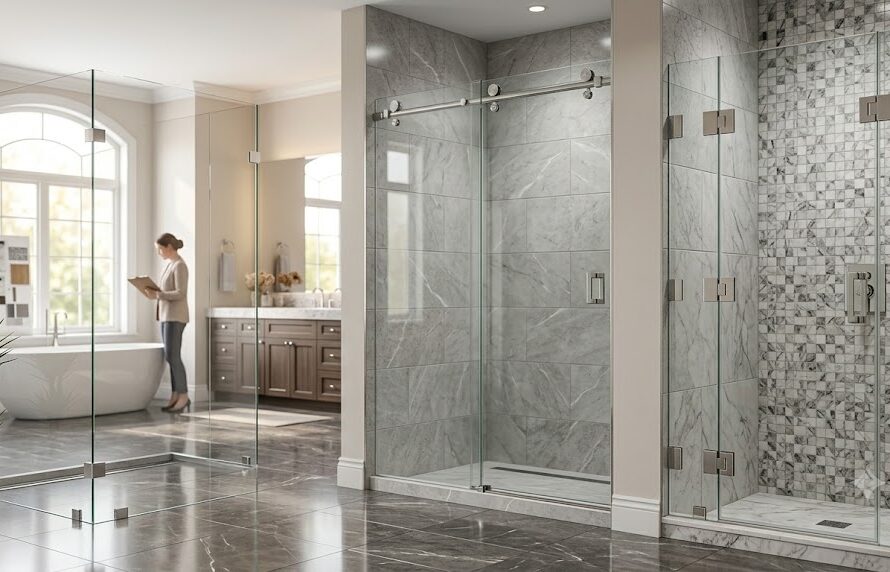
Choosing the right shower glass thickness is one of the most important decisions you’ll make when designing a bathroom. It affects how your shower looks, how safe it is, how long it lasts, and how much it costs. Yet most homeowners — and even some contractors — treat it as an afterthought.
At Berwyn Glass, we’ve been helping customers select the right glass specifications for shower doors and enclosures for years. This guide breaks down everything you need to know about the three most common options: 6mm, 8mm, and 10mm tempered safety glass — so you can make a confident, well-informed choice.
Why Shower Glass Thickness Matters
Before comparing the numbers, it’s worth understanding why thickness matters in the first place.
Shower glass isn’t like a window or a picture frame. It takes daily physical impact — doors slamming shut, water pressure, accidental knocks, and the weight of hardware like hinges and handles. The wrong shower glass thickness can flex under load, create rattling or instability, and in worst cases, compromise safety.
Thickness also affects the visual weight of the glass. Thicker panels have a denser, more premium appearance. When you look at a high-end hotel bathroom with a seamless frameless enclosure, chances are you’re looking at 10mm glass — and it shows.
Here’s a key point: all shower glass used in residential and commercial settings should be tempered safety glass. Tempered glass is heat-treated to be four to five times stronger than standard glass, and when it does break, it shatters into small, blunt pieces rather than dangerous shards. So when we talk about safety glass thickness, we’re always talking about tempered glass as the baseline.
6mm Shower Glass: The Entry-Level Option
6mm shower glass is the thinnest option commonly used in shower enclosures, and it has a legitimate place in the market — but also clear limitations.
Where 6mm Works
This thickness is typically used in:
- Framed shower doors and enclosures, where the aluminium or steel frame provides structural support
- Sliding door systems, where the glass panels don’t bear the full weight of heavy hardware
- Budget-conscious projects where aesthetics are secondary to function
- Secondary bathrooms in rental properties or entry-level developments
Because the frame carries much of the structural load, 6mm glass performs adequately in framed systems. The glass doesn’t need to support hinges or handle the stress of being freestanding.
Where 6mm Falls Short
The limitations become apparent in frameless or semi-frameless designs. Without a frame to distribute stress, 6mm panels can flex noticeably when the door is opened or closed. Over time, this flexing puts strain on fixings and hardware, leading to premature wear.
Glass weight is also lower with 6mm, which some people consider a benefit — easier installation, less load on wall fixings — but in shower doors, a certain weight actually contributes to a quality feel. A lightweight door tends to feel cheap and less controllable in operation.
From a shower door glass spec perspective, 6mm is also less tolerant of thermal stress. Showers expose glass to repeated hot-cold cycles, and while tempered glass handles this well, thicker glass does so with greater margin.
Summary — 6mm shower glass:
- Best for: framed enclosures, sliding doors, budget installs
- Not ideal for: frameless designs, pivot doors, heavy hardware
- Typical weight: approximately 15 kg/m²
8mm Shower Glass: The Balanced Choice
8mm shower glass is the most widely used thickness in the UK and across much of Europe, and for good reason. It sits in the sweet spot between cost, performance, and aesthetics.
The Case for 8mm
For the majority of shower enclosures — both framed and semi-frameless — 8mm tempered glass delivers everything you need:
- Adequate rigidity for doors with standard pivot or inline hinges
- Good glass weight that feels substantial when opening and closing
- Visual presence without the bulk or cost of 10mm
- Compatibility with most standard shower hardware on the market
8mm is the standard specification for most shower door glass specs in mainstream residential construction. Most off-the-shelf shower enclosures are built around 8mm panels, meaning hardware, seals, and profiles are all designed and tested for this thickness.
From a practical standpoint, 8mm glass is also easier to source, cut, and install than 10mm. Lead times tend to be shorter, and the range of available treatments — including anti-limescale coatings, frosted finishes, and tinted glass — is broader.
8mm in Semi-Frameless Designs
One of the strongest use cases for 8mm glass is the semi-frameless enclosure. Here, the top and bottom of the glass are supported by profiles, but the sides are relatively open. The 8mm thickness provides enough stiffness to prevent flex without requiring the full structural overkill of 10mm.
It’s also the minimum recommended thickness for shower doors over 1800mm in height. Tall panels need more rigidity to avoid the “whip” effect — a subtle but annoying flexing motion that occurs when tall, thin panels are opened forcefully.
Summary — 8mm shower glass:
- Best for: semi-frameless enclosures, standard pivot doors, most residential projects
- Good for: tall panels (up to ~2100mm), mid-range to high-end bathrooms
- Typical weight: approximately 20 kg/m²
10mm Shower Glass: The Premium Standard
10mm frameless shower enclosures represent the pinnacle of residential shower design. If you’ve ever walked into a bathroom and felt that the shower looked genuinely luxurious — not just clean, but architecturally considered — you were almost certainly looking at 10mm glass.
Why 10mm is Different
The difference isn’t just thickness; it’s how that thickness changes the entire character of the installation.
Structural integrity is dramatically higher. 10mm tempered glass is stiff enough to be completely freestanding as a walk-in panel with no top or side support. This opens up design possibilities that simply aren’t available with thinner glass — fully open walk-in showers with a single glass screen, for example, or large glass panels spanning from floor to ceiling without intermediate fixings.
Glass weight increases to approximately 25 kg/m², which sounds like a drawback but is actually a selling point. A heavy door with quality hinges operates with a deliberate, controlled feel that lighter doors simply can’t match. There’s a reason that high-specification hardware manufacturers — the ones producing concealed hinges and frameless door pulls — engineer their products around 10mm glass.
Visual depth is also noticeable. Look at the edge of a 10mm panel and you’ll see a deep green tint (or minimal tint in low-iron glass). This depth is part of the premium aesthetic. At Berwyn Glass, we often specify low-iron 10mm glass for clients who want that ultra-clear look — no greenish cast, just pure transparency.
Is 10mm Always Better?
Not necessarily. There are contexts where 10mm is unnecessary or even counterproductive:
- Small enclosures with lots of fixed panels: the added weight strains fixings and can make installation harder without meaningful benefit
- Curved glass: thicker glass is harder and more expensive to bend, so 6mm or 8mm is standard for curved shower screens
- Very tight spaces: the structural advantages of 10mm matter less when the glass is fully supported on multiple sides
But for open walk-in showers, large format frameless enclosures, and any project where design quality is non-negotiable, 10mm is the specification to choose.
Summary — 10mm frameless shower glass:
- Best for: frameless and walk-in enclosures, feature bathrooms, high-end residential and commercial
- Not ideal for: curved glass, small enclosed cubicles, tight budget projects
- Typical weight: approximately 25 kg/m²
Side-by-Side Comparison: 6mm vs 8mm vs 10mm
| Feature | 6mm | 8mm | 10mm |
|---|---|---|---|
| Best application | Framed / sliding | Semi-frameless | Frameless / walk-in |
| Structural rigidity | Low | Medium | High |
| Glass weight (kg/m²) | ~15 | ~20 | ~25 |
| Frameless suitability | No | Partial | Yes |
| Hardware compatibility | Limited | Wide | Premium |
| Relative cost | £ | ££ | £££ |
| Safety (tempered) | Yes | Yes | Yes |
Tempered Glass Thickness and Safety Ratings
All three thicknesses, when properly manufactured as tempered safety glass, comply with BS EN 12150 (the UK standard for thermally toughened soda lime silicate safety glass). This means that regardless of whether you choose 6mm, 8mm, or 10mm, the glass will:
- Pass impact resistance testing
- Break into small, relatively harmless fragments rather than sharp shards
- Meet building regulations for use in bathrooms and wet rooms
What thickness changes is not the type of safety but the margin of safety. A thicker panel has a higher resistance to impact before reaching its failure point. For family bathrooms, wet rooms accessible to elderly users, or any situation where accidental impact is more likely, specifying 8mm or 10mm over 6mm is a sensible precaution.
How to Choose the Right Shower Glass Thickness for Your Project
Here’s a simple decision framework to guide your choice:
Choose 6mm if:
- You’re specifying a framed enclosure with full perimeter support
- Budget is the primary concern
- The design uses a sliding door mechanism
Choose 8mm if:
- You’re fitting a semi-frameless or standard frameless hinge door
- The enclosure height is between 1800mm and 2100mm
- You want a quality result without the full cost premium of 10mm
Choose 10mm if:
- You’re creating a fully frameless walk-in shower or open enclosure
- The design has large, unsupported glass panels
- Aesthetics and feel are paramount
- You’re specifying a high-end bathroom or commercial installation
What Berwyn Glass Recommends
At Berwyn Glass, our most commonly specified product for residential projects is 8mm low-iron tempered glass — it hits the right balance of performance, aesthetics, and value for the vast majority of shower enclosure types.
For clients investing in a designer bathroom, we regularly specify 10mm ultra-clear tempered glass, particularly for walk-in panels and large format frameless enclosures. The visual impact and the quality of movement when using the shower are noticeably different, and in a high-specification bathroom, those details matter.
We also stock 6mm tempered glass for framed systems and sliding doors where structural demands are lower and budget is a priority.
Whatever your project, we’d recommend discussing the full shower door glass spec with a specialist before ordering. Glass thickness affects not just the panels themselves but the choice of hardware, the fixings into the wall, and the weight load on the floor or tray. Getting the specification right from the start saves costly adjustments later.
Final Thoughts
Shower glass thickness isn’t a minor technical detail — it’s a fundamental design decision that shapes the look, feel, safety, and longevity of your shower enclosure. The choice between 6mm shower glass, 8mm shower glass, and 10mm frameless shower glass comes down to the type of enclosure, the design intent, and the budget available.
For most homeowners, 8mm is the answer. For those pushing for the best, 10mm delivers a result that’s hard to match. And for straightforward framed installations, 6mm does the job reliably and economically.
If you’re unsure which tempered glass thickness is right for your project, the team at Berwyn Glass is happy to help. We offer a full consultation and quotation service, and we can advise on everything from glass specification to hardware selection and installation.
This guide was produced by Berwyn Glass. All specifications are provided for general guidance; always consult a qualified glazing professional for project-specific advice.