
How to Use Plane Mirrors to Make Small Rooms Look Larger

Plane mirrors in gladwyne are flat sheets of glass that reflect light and repeat visual edges, creating a convincing optical cue that makes compact rooms read as larger and brighter. In this guide we explain the science behind that effect, show smart placement strategies, compare mirror types and finishes, and share actionable steps you can use right away to improve depth and daylight in tight interiors. Whether you own or rent, cramped proportions, low light, and awkward sightlines are common problems — the right mirror, sized and installed thoughtfully, is a low-impact design move that boosts perceived square footage, evens out light, and upgrades a room’s look. Below you’ll find clear placement patterns, product trade-offs, customization options from Berwyn Glass Co., installation and safety considerations, plus real-world examples that make these techniques easy to apply.
How Do Plane Mirrors Create the Illusion of a Larger Room?
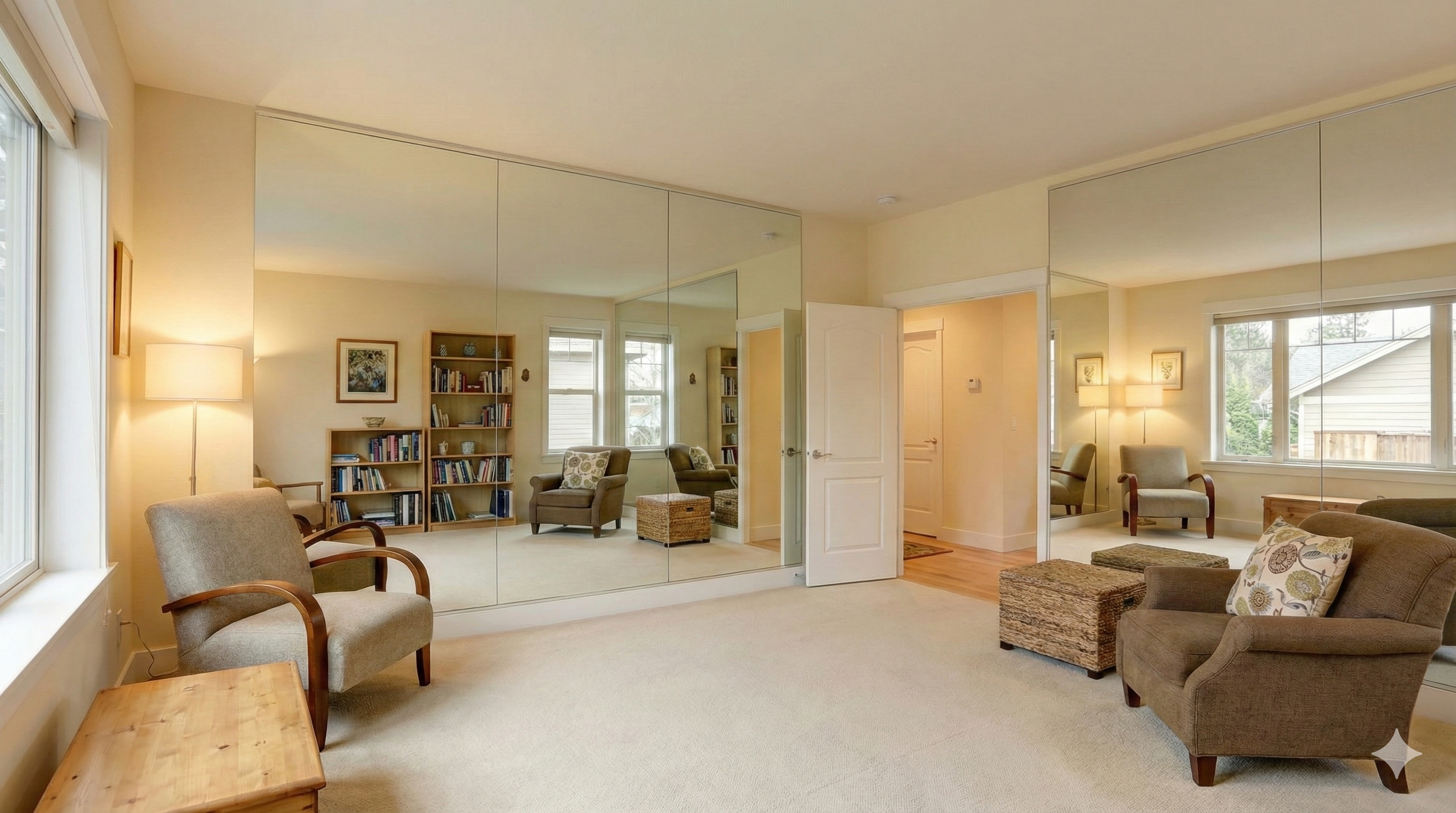
Mirrors trick the eye by reflecting light and repeating familiar visual cues, effectively extending the lines our brains use to judge space. When a mirror captures a window, furniture, or an architectural detail, the reflected scene reads as additional volume — increasing perceived depth and brightness. This effect works best when reflections maintain consistent perspective and an uninterrupted reflective plane, so you can use mirror size and position to steer sightlines and light for the most convincing result.
How Does Light Reflection Amplify Small Room Brightness?
A mirror brightens a room simply by redirecting daylight and fixture light into darker corners. Placing a mirror across from a window or near a lamp redistributes existing light, reduces harsh shadows, and makes surfaces appear lighter and more open — all without adding new fixtures. Practically speaking, a slight angle toward a light source helps spread illumination evenly instead of creating concentrated glare.
Pro tip: tilt mirrors a few degrees toward windows or lamps to diffuse light rather than catch it directly as a hotspot.
What Optical Illusions Do Plane Mirrors Produce to Expand Space?
Plane mirrors create several complementary illusions that together expand perceived space: visual duplication, continuity of architectural lines, and perspective extension.
Visual duplication repeats objects and patterns so the eye reads more area. Continuity removes visual breaks by creating seamless reflective planes. Perspective extension lengthens sightlines by reflecting vanishing points. Using a mirror to capture a long view — a hallway or row of windows, for example — leverages perspective extension most effectively and produces a convincing sense of added depth.
Berwyn Glass Co. brings hands‑on craft and precision installation to these optical tactics, offering custom mirror fabrication and fit‑out for homes and businesses in places like Phoenixville, Ardmore, and Gladwyne, PA. Working with experienced fabricators reduces common problems — loose anchors, visible seams, or awkward proportions — so your mirror performs as intended and stays safe over time. If you prefer a professional to translate mirror theory into a custom, site‑specific solution, we provide consultation and tailored mirror options that work with local architecture.
Where Should You Place Plane Mirrors for Maximum Space Enhancement?

Placement determines a mirror’s impact: opposite windows, behind key furniture, and along primary sightlines deliver the biggest spatial gains. Thoughtful locations either increase reflected daylight, double important focal points, or extend architectural lines so the eye perceives continuity past the real wall. Good placement also respects safety and proportion — mirrors should relate to the wall size and be mounted at heights that preserve natural sightlines and avoid awkward clutter reflections. Below are practical patterns and the reasoning behind them to help you map mirror positions for specific small‑room scenarios.
Most effective placements include:
- Opposite a window: Captures natural light and outdoor views, boosting brightness and perceived depth.
- Full‑length in a corner: Angled corner mirrors catch multiple sightlines, adding visible height and width.
- Behind a sofa or console: Reflects the room’s activity and the opposite wall, visually doubling the space behind large furniture.
- Along a hallway: Long, slim mirrors or staggered panels break the corridor’s linearity and make it feel wider and longer.
Each placement emphasizes either light amplification, perspective extension, or removal of visual breaks; choose the solution that fits the room’s features and your design goals.
| Room Type | Recommended Placement | Expected Visual Effect |
|---|---|---|
| Living room | Opposite window or behind seating | Brighter space; perceived depth behind furniture |
| Bedroom | Full-length mirror on wardrobe door or wall | Added height and apparent room length |
| Hallway/entryway | Long, horizontal panels along wall | Wider appearance and improved light flow |
| Dining room | Mirror behind sideboard or buffet | Extended dining area and reflected table continuity |
Use this quick reference to match room function with mirror strategies so you can prioritize either light or perspective depending on the space.
Why Is Opposite Window Placement Ideal for Reflecting Natural Light?
Placing a mirror opposite a window captures the room’s strongest light source and can dramatically increase daylight penetration. The mirror catches incoming sky and sun and sends that light into shadowed corners, lowering contrast and making the room feel more open. Be mindful to avoid bouncing direct sun onto delicate fabrics and angle mirrors to spread light rather than concentrate glare.
Example: a mirror across from a south‑facing window will catch late‑day light and help it wash across seating areas for an airy feel.
How Do Full-Length Mirrors Add Height and Length to Small Rooms?
Vertical full‑length mirrors emphasize height, prompting the eye to read taller proportions; long horizontal mirrors widen perceived breadth. Leaning a tall mirror against the wall creates a relaxed height boost, while flush mounting gives a cleaner, uninterrupted plane that reads more seamless.
For best results, set the mirror’s lower edge close to the floor and align the top near the ceiling line to strengthen the height illusion. To extend length, place mirrors parallel to the room’s longest wall or opposite a long window.
Can Mirrored Walls and Panels Seamlessly Expand Visual Boundaries?
Wall‑to‑wall mirrors and large panels deliver the strongest sense of continuity when seams and framing are minimized.
Frameless, full‑wall installs produce the most convincing effect but need exact measurement, tempered glass where required, and professional mounting to conceal seams and ensure safety.
Panelized systems are easier to install and maintain; although seams may be visible, aligning panels with architectural lines preserves the illusion. Weigh visual continuity against installation complexity when choosing between full mirrored walls and panel approaches.
How Does Placing Mirrors Behind Furniture Double Visual Depth?
Mirrors behind sofas, consoles, or buffets reflect the room’s active side and give the impression that space continues beyond the furniture. This is most effective when the reflected view includes a window, artwork, or an open sightline, because those elements define depth.
Keep a small reveal behind furniture for airflow and avoid reflecting cluttered surfaces, which can reduce perceived depth. Correct mounting height ensures reflected horizons and focal points line up with the viewer’s sightline for maximum effect.
What Are the Best Mirror Placements for Narrow Hallways and Entryways?
In narrow passages, long horizontal mirrors or staggered panels interrupt linear monotony and visually widen the corridor by reflecting side light and adjacent rooms. Mount them at eye level and consider a rhythmic grouping of narrow mirrors to add interest without crowding the space.
Reflecting the hallway’s end or the front door can create the sense of extra depth; for safety, use secure hardware and consider tempered glass in high‑traffic zones to reduce breakage risk.
What Types of Plane Mirrors Work Best to Make Small Rooms Look Bigger?
Choosing the right mirror balances clarity, safety, edge treatment, and aesthetics. Frameless full‑length mirrors produce the most uninterrupted reflections for spatial enhancement.
Glass choice matters: low‑iron glass reduces the green tint for truer reflections, while tempered glass improves safety for large installations.
Frame styles affect continuity — slim or no frames preserve reflection, while decorative frames create a visible object that can interrupt perceived space. Below is a comparison to help you decide.
- Frameless mirror: Ideal when you want seamless reflection and a modern, minimal look that maximizes perceived space.
- Framed mirror: Best when the mirror should read as a decorative focal point; choose narrow frames to retain as much continuity as possible.
- Tempered mirror: Recommended for large formats and high‑traffic areas where safety and durability matter most.
| Mirror Type | Best Room Type | Key Attribute |
|---|---|---|
| Frameless full-length | Modern living rooms, bedrooms | Seamless reflection, minimal visual interruption |
| Framed decorative | Traditional interiors, focal walls | Adds style but reduces continuous reflection |
| Tempered panel | Hallways, bathrooms, high-traffic zones | Enhanced safety and durability |
This comparison clarifies the trade‑offs: frameless and low‑iron glass favor optical expansion, while tempered glass prioritizes safety when using large reflective surfaces in active spaces.
Berwyn Glass Co. fabricates and installs frameless, framed, and tempered mirrors tailored to interior needs. Our custom cutting and precise installation ensure chosen glass types perform as expected in compact rooms.
We also offer specialized glass work — like our modern grid showers — that pairs design and practicality for bathroom projects.
How Do Frameless and Framed Mirrors Differ in Aesthetic Impact?
Frameless mirrors minimize interruptions to the reflective surface, so the eye reads an extended plane; framed mirrors make a statement but inherently break continuity. Frameless systems pair well with low‑iron glass for crisp reflections and suit contemporary interiors where maximum enlargement is the goal. Framed mirrors work when you want a defined focal point or to echo trim — just keep frames slim to preserve as much reflection as possible. Decide whether optical expansion or decorative identity is your priority.
Which Glass Types and Finishes Enhance Light and Style in Small Spaces?
Low‑iron glass offers clearer reflections and truer color by minimizing the green cast of standard glass. Standard silvered glass is more budget‑friendly and still effective for many rooms.
Tempered glass is advised for large mirrors or high‑use areas for safety. Edge finishes — polished, beveled, or painted — influence both appearance and how reflections terminate at the perimeter.
Trade‑offs include cost, clarity, and longevity: low‑iron and tempered options cost more but deliver better optics and longer life. Specifying the right combination ensures your mirror amplifies light and stands up to daily use.
How Does Mirror Size and Proportion Affect Room Perception?
To convincingly enlarge a room, a mirror should cover a substantial portion of the wall or furniture face — a common rule is at least half the wall height for height effects, or matching mirror length to furniture length for balanced reflections.
Oversized mirrors have greater impact but must remain proportionate to ceiling height and surrounding trim to avoid looking overpowering. Keep proper clearances from furniture and align the main reflective horizon with typical eye level for comfortable, natural views.
| Mirror Option | Customization | Benefit |
|---|---|---|
| Tempered full-length | Polished or beveled edge | Safety with a refined finish |
| Frameless wall panel | Custom cut to wall dimensions | Seamless continuity and maximal brightness |
| Framed accent mirror | Choice of frame material/finish | Architectural cohesion with decorative control |
This table maps common customization choices to their practical benefits so you can pick options that serve both aesthetics and performance in small rooms.
How Can Custom Plane Mirrors from Berwyn Glass Co. Transform Small Rooms?

Custom mirrors can be cut and finished to fit odd walls, match trim, and create continuous reflective planes that produce the strongest visual expansion. Precision cutting eliminates awkward gaps and produces a tailored result that off‑the‑shelf mirrors can’t match.
At Berwyn Glass Co. we focus on craftsmanship and accurate installation so mirrors fit properly, complement local architectural styles, and stay secure for the long term.
Options like beveled edges, subtle backpaint colors, and custom cutouts let mirrors integrate cleanly into both traditional and modern interiors without compromising the optical effect. For homeowners who want the best outcome, custom fabrication avoids sizing and seam issues common with ready‑made pieces.
What Are the Benefits of Tailored Mirror Designs for Unique Spaces?
Tailored mirrors remove awkward gaps and mismatched proportions by being cut to exact wall dimensions and shapes. This is especially useful for irregular nooks, arched openings, or angled ceilings, where a custom panel reads as an uninterrupted reflective surface.
Custom shapes — arches, circles, or unique panel layouts — can enlarge a room while also serving as a considered design element that echoes local moldings and window proportions. Reducing seams and aligning mirrors with architectural sightlines improves the illusion of depth and creates a polished finished look.
Clients gain both better optical performance and a personalized aesthetic outcome.
Why Is Professional Installation Crucial for Safety and Visual Effect?
Professional installers make sure mirrors are anchored correctly, level, and fitted with hardware sized to the glass type and weight. That attention preserves optical alignment and prevents vibration or failure over time.
Installers use mounting methods and hardware matched to the mirror’s size — especially for tempered panels — and check that reflected sightlines meet the design intent. Without professional mounting, mirrors can sag, shift, or present hazards in busy areas; precise installation hides fasteners and supports a seamless appearance. In short, good installation preserves both safety and the intended visual result.
How Do Quality and Durability Make Custom Mirrors a Lasting Investment?
Higher‑quality materials and protective finishes resist silvering, moisture intrusion, and edge corrosion, so custom mirrors retain clarity longer than inexpensive alternatives.
Durable hardware and tempered glass reduce lifecycle risk and lower replacement and maintenance costs — an upfront investment that pays off over years of continued performance.
Choosing professional‑grade glass and finishes reduces optical distortion and ensures the mirror keeps reflecting light and depth as intended. That longevity supports a clear ROI: a better‑made mirror keeps your space looking larger and more refined for longer.
| Mirror Option | Attribute | Value |
|---|---|---|
| Custom-cut frameless | Exact wall fit, polished edge | Seamless continuity, enhanced brightness |
| Tempered panel | Safety-rated glass, secure mounting | Reduced breakage risk, suitable for traffic areas |
| Beveled or backed finish | Decorative edge, protective coating | Improved style, resistance to silvering |
Berwyn Glass Co. centers our service on tailored solutions, quality materials, and precise installation — the combination that ensures custom mirrors deliver on both safety and the desired visual enlargement.
If you’re ready to explore custom options, contacting a professional fabricator like Berwyn Glass Co. moves a design from idea to measured installation, producing a mirror that expands space and complements your home’s character.
We also provide inventive solutions for compact bathrooms, including custom sliding showers that pair clean design with everyday practicality.
What Are Additional Tips for Using Mirrors to Reflect Light and Expand Space?
Small rooms benefit most from combined strategies: layer lighting, control reflected clutter, and choose mirror styles that suit the room’s scale and decor. Mirrors should reflect pleasant views or light rather than busy messes; keeping reflected scenes tidy reinforces the sense of space. Pair mirrors with multiple light sources — ambient, task, and accent — and let the glass help balance the room’s illumination.
Here are a few practical pairings to try:
- Layer lighting behind and beside mirrors: Wall sconces or picture lights produce even illumination that mirrors can redistribute.
- Keep reflected scenes simple: Declutter surfaces the mirror will show so reflections enlarge rather than crowd the view.
- Prefer narrow frames or frameless styles: Minimal framing preserves reflection continuity and maximizes perceived space.
These steps combine mirror choice with lighting and housekeeping to reinforce the optical strategies described above.
How Can Mirrors Amplify Both Natural and Artificial Light Sources?
Mirrors work best when paired with layered lighting: they bounce daylight and fixture light into dark zones so rooms feel brighter overall. Place mirrors to catch lamp light and redirect it to corners, and choose diffused fixtures to avoid sharp glare in reflections.
Using warm‑tone accent lights with mirrors creates gradations of light that enhance depth rather than flattening the room into uniform brightness.
Quick checklist: position mirrors opposite light sources, angle to reduce glare, and avoid reflecting bare bulbs directly to maintain comfort while maximizing spread.
What Decorative Mirror Styles Enhance Small Room Elegance and Functionality?
Pick mirror styles that support the room’s character while serving expansion goals: arched mirrors soften and lengthen sightlines in traditional rooms; a single sculptural or sunburst mirror can provide a focal point without overwhelming when used sparingly; and frameless panels keep a modern, uncluttered look.
Match frame materials and tones to existing trim so the mirror reads as part of the space rather than an island. Subtle ornamentation preserves reflection continuity while adding finishing detail.
Thoughtful styling keeps mirrors both useful and beautiful.
Where Can You See Examples of Plane Mirrors Making Small Rooms Look Larger?
Real projects show how strategic mirror placement and custom fabrication produce noticeable gains in perceived size and brightness. In many case studies, mirrors placed opposite windows increase daylight, full‑length mirrors in bedrooms add vertical presence, and mirrored panels in living areas expand seating zones visually.
Seeing results in homes with proportions similar to yours sets realistic expectations for how much a mirror can change the feel of a room.
What Are Real-Life Transformations Using Custom Mirrors in Small Spaces?
Custom mirrors often solve awkward layouts by filling irregular walls with tailored reflective panels, producing measurable gains in perceived square footage and brightness. These installations typically result in rooms that feel airier and more cohesive because sightlines are extended and light is redistributed to formerly dim corners.
Installers repeatedly note the value of accurate measurements, choosing tempered or low‑iron glass where appropriate, and secure anchoring to meet both optical and safety goals.
These examples show how deliberate mirror strategies translate into practical improvements.
How Do Local Architectural Styles Influence Mirror Design Choices?
Local details — moldings, window proportions, and ceiling heights — should guide mirror selection so reflections complement, rather than clash with, a home’s character. In traditional interiors, mirrors with subtle frames or arched tops can echo trim lines; in modern open plans, large frameless panels often deliver the best continuity.
In service areas such as Phoenixville, Ardmore, and Gladwyne, matching finishes and edge details to existing materials helps mirrors read as integrated design elements that enlarge rather than isolate a space.
Taking regional style into account ensures your mirror choice supports both spatial goals and architectural coherence.
Frequently Asked Questions
What are the safety considerations when installing plane mirrors?
Safety comes first. Use the right anchors and mounting hardware for the mirror’s size and the wall type, and choose tempered glass for high‑traffic areas to reduce breakage risk. Think about mounting height to avoid accidental contact, especially in homes with children or pets. Professional installation is recommended to ensure mirrors are level, secure, and properly supported over time.
How can I maintain the clarity and shine of my mirrors?
Clean mirrors regularly with a gentle glass cleaner and a soft, lint‑free cloth to avoid scratches. Wipe in smooth motions to minimize streaks. Keep mirrors out of prolonged high humidity whenever possible — moisture can accelerate silvering breakdown. In bathrooms, use an exhaust fan or dehumidifier to reduce moisture exposure.
Can mirrors help with sound acoustics in small rooms?
Mirrors reflect sound as well as light, so large glass surfaces can introduce echoes in tight spaces. Balance reflective surfaces with soft furnishings — rugs, curtains, and upholstered furniture — to absorb sound and keep the room comfortable while still benefiting from visual expansion.
What are some creative ways to use mirrors in small spaces beyond traditional placements?
Try integrating mirrors into furniture — mirrored coffee or console tables — or build a gallery of mixed framed and frameless mirrors for texture and light. Mirrored tiles can serve as a kitchen or bathroom backsplash to boost brightness. These alternative uses add function and visual depth without relying solely on wall mirrors.
How do I choose the right size mirror for my small room?
Choose proportions that relate to the wall and furniture: aim for at least half the wall height for height effects, or match mirror width to furniture length for a balanced look. Oversized mirrors are impactful but should respect ceiling height and trim so they feel intentional rather than overwhelming.
What types of frames are best for maximizing the illusion of space?
Minimal or frameless mirrors are the best choice for maximizing perceived space because they maintain uninterrupted reflections. Narrow frames can work if they’re subtle; avoid bulky or ornate frames that break the visual flow and make the mirror read as a separate object.
How can I incorporate mirrors into my decor style without compromising aesthetics?
Choose mirrors that coordinate with your existing finishes and furniture. For modern interiors, lean toward frameless or slim profiles; for traditional spaces, select frames that echo architectural lines without overpowering the reflection. Use mirrors to highlight attractive views or artwork so they enhance both function and style.
Conclusion
When chosen and placed with intention, plane mirrors transform small rooms by increasing light, extending sightlines, and improving the overall feel of a space. Strategic mirror selection, paired with proper installation and a few lighting and styling choices, delivers a big visual return for a relatively small investment. For tailored solutions that respect your home’s details, reach out to professionals like Berwyn Glass Co. to explore custom mirror options that both expand and elevate your interiors.